

 English
 中文简体
 русский
 Español


Industry News
 +86-13306862930 / +86-18668881826
Get a Quote
+86-13306862930 / +86-18668881826
A linear axis can pass every dimensional check and still be the loudest thing on the floor. People who work beside a rack and pinion drive notice noise long before anyone writes it into a report, and the sound often points to something deeper than tooth shape: vibration, alignment, lubrication or load. Even so, tooth geometry is the first thing engineers compare. When choosing between a Helical Rack Gear and a Spur Gear Rack and Pinion, the usual question is whether angled teeth really make the drive quieter. Generally yes, but how much quieter depends on engagement, speed, load, manufacturing quality and installation accuracy.
As automated lines, precision motion systems and connected machines spread, acoustic comfort has become a design target of its own. Operators work longer shifts near equipment, inspection stations need quiet surroundings, and unusual noise is often the first sign that a transmission is wearing. That is why the rack choice deserves more than a glance at a price list.
Helical racks generally run quieter than comparable spur racks, and the reason lies in how the teeth meet. A helical tooth is inclined, so contact begins at one end and spreads across the face as the pinion turns. That gradual entry softens changes in contact force and limits vibration.
A spur rack has straight teeth parallel to the pinion axis, so the full tooth width engages at nearly the same instant. This gives a more direct, abrupt engagement that can become audible at higher speeds, under fluctuating loads, or when alignment is off.
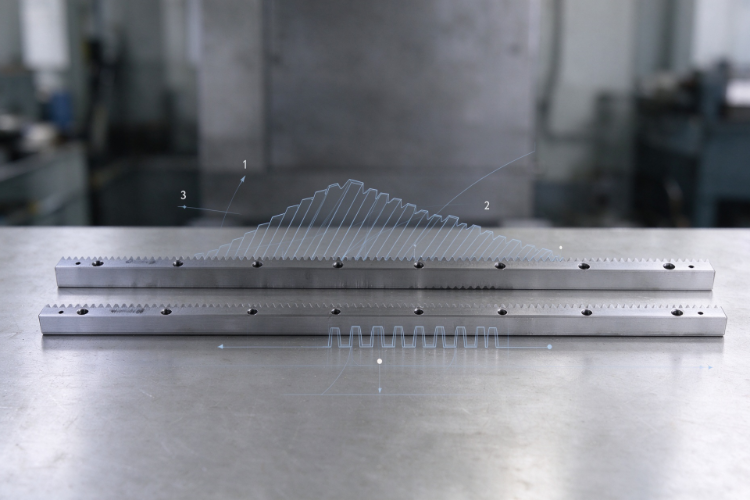
Tooth form alone does not set the final sound level, though. A precisely ground spur rack with good lubrication can run more quietly than a poorly installed helical one. Think of tooth geometry as a head start, not a guarantee.
| Feature | Helical Rack | Spur Rack |
|---|---|---|
| Tooth direction | Angled | Straight |
| Engagement | Progressive | Direct |
| Operating noise | Generally lower | May be more noticeable |
| Vibration | Generally smoother | Depends on conditions |
| Axial thrust | Present | Generally negligible |
| Manufacturing | More complex | Simpler |
| Initial cost | Often higher | Often lower |
Progressive engagement. As the pinion rotates, different parts of the tooth surfaces enter and leave contact in sequence, so force changes smoothly. With straight teeth, force transitions are sharper, especially during rapid moves or fluctuating loads. For machinery that repeats positioning cycles thousands of times a day, that gentler hand-off makes motion feel more controlled and keeps the sound steadier.
Overlapping contact. A helical rack can keep more than one tooth pair sharing the load at a given moment. Spreading force across the engagement area, rather than concentrating every change at a single instant, limits vibration. Spur racks still transmit load reliably, but their quietness leans more heavily on tooth accuracy, pinion design and operating conditions.
Less structural excitation. Noise is usually vibration in disguise. Repeated impacts at the tooth mesh travel into brackets, frames and mounting plates, which then radiate sound of their own. A thin steel guard or a long unsupported frame can act like a speaker, amplifying a modest mesh vibration into something obvious. Reducing the source reduces what the structure amplifies, which matters in automated machines where a quiet environment is part of the specification.
Noise is only one selection factor. Load, mounting and maintenance matter just as much.
Load capacity. Overlapping contact can support smooth load transmission, but it does not mean every helical rack carries more than every spur rack. Material, tooth size and face width, heat treatment, surface hardness, mounting rigidity, actual load and lubrication all decide the result. A properly specified spur rack may meet the load requirement without the extra design work that a helical system demands.
Axial thrust. Because the teeth are inclined, engagement creates a force along the pinion axis. The machine must absorb it through suitable bearings, supports and mounting. A spur rack does not generate the same thrust from tooth engagement, which can simplify the layout. If the pinion shaft or its bearings are marginal, ignoring this thrust can turn a quiet design into a noisy, short-lived one.
| Consideration | Helical Rack | Spur Rack |
|---|---|---|
| Axial force | Must be managed | Generally not required |
| Bearings | Must handle axial load | Usually simpler |
| Mounting design | Needs extra attention | Relatively straightforward |
| Motion | Progressive | Direct |
This distinction matters most in compact machines or wherever mounting space is limited.
Manufacturing and upkeep. Both rack types depend on accurate tooth geometry and good surface finish. Manufacturing errors cause uneven contact, and poor mounting creates localized loading. Insufficient lubrication raises friction, which adds noise, heat and premature wear. Helical racks involve more geometric complexity, but both types need regular inspection, cleaning and relubrication.
A quieter tooth form cannot rescue every mechanical problem. Before blaming the rack type, look at the whole system.
Manufacturing accuracy. Variations in tooth spacing, profile or surface finish interrupt smooth engagement. Each small irregularity becomes a tiny impact, and those impacts add up to audible noise.
Alignment. Wrong mounting height, uneven rack support, a poorly positioned pinion, inconsistent engagement clearance or weak mounting rigidity all produce uneven contact. Careful setup keeps contact consistent and reduces stress on the teeth.
Rack joints. On long travels, sections are butted together. A small step or pitch error at a joint creates a knock each time the pinion crosses it.
Lubrication. The lubricant must suit the application, speed and environment. Too little means friction and wear, while contaminated grease can be just as harmful.
Operating conditions. Rapid acceleration, changing loads and frequent reversals introduce additional vibration regardless of tooth form.
Surrounding components. Worn bearings, loose fasteners, a flexible frame or a badly tuned motor can drown out the benefit of the best rack.
For this reason, evaluate noise under real operating conditions instead of relying only on the nominal rack type. A short run on the actual machine, with the actual load, tells you far more than a catalog description.
Strengths. Quieter transmission through gradual engagement, smooth linear movement from overlapping contact, load sharing across several teeth, and good suitability for precision equipment that needs controlled motion.
Limits. The pinion support must handle axial thrust, the angled geometry needs suitable machining and inspection, rack positioning and pinion alignment need careful attention, and the initial cost can be higher than a plain spur arrangement. The right choice depends on whether the operating benefits justify these extra requirements.
Choose a helical rack when acoustic performance and smooth movement matter. Typical uses include CNC machine tools, robotic positioning equipment, automated assembly systems, precision linear positioning machinery and production equipment with frequent movement cycles. In these settings progressive engagement reduces transmission vibration and supports steadier motion. Before finalizing the design, confirm axial thrust handling, pinion support and lubrication.
Choose a spur rack when structural simplicity and cost take priority. It suits general industrial machinery, material handling equipment, conventional automation, machines with moderate noise requirements and linear drives with straightforward mounting. The straight tooth design simplifies manufacturing and mechanical integration, and when noise is not a restrictive requirement, a spur rack is a practical, economical solution.
Review these points with your design and purchasing teams:
A clear written specification makes conversations between designers, buyers and manufacturers much easier. It also reduces the chance of receiving a rack that looks right on paper but does not suit the machine.
Automated systems depend on reliable movement between working positions, so the transmission must match the machine's speed, load, accuracy and environment.
Helical racks appear in CNC machine tools, industrial robotic positioning, automated production lines, precision material positioning and other machinery needing controlled linear motion. In each case, smoother engagement helps keep both noise and positioning variation low.
Spur racks remain common in material transfer machinery, general-purpose automation, lifting and positioning mechanisms, conventional drives and cost-conscious designs. Their simplicity makes them easy to specify, mount and replace. The decision follows the required movement characteristics and the structure of the whole machine, not a blanket rule that one type is better than the other.
Comparing a Helical Rack Gear with a Spur Gear Rack and Pinion is easier with real numbers in front of you. Send our team your drawings, operating speed, load, noise target and mounting conditions, and we will help clarify which tooth form and specification fit your equipment. Contact us to start a product selection discussion.

© 2025 Zhejiang Yuchen Transmission Technology Co., Ltd.

Transmission Gear And Rack


