A CNC gantry reverses direction hundreds of times during a single job, and the operator hears a faint rattle at each change. A pick-and-place axis hums quietly yet drifts a fraction of a millimeter after a long shift. Both complaints trace back to the same mechanism, but they have different causes. Choosing between a Helical Rack Gear and a Spur Gear Rack and Pinion involves more than comparing tooth shapes. A Helical Rack Pinion engages progressively and tends to run more quietly, while positioning accuracy depends on backlash, manufacturing tolerance, mounting, and stiffness working together. Both goals demand careful engineering. Holding position consistently is usually the harder one, because more mechanical and control factors act on it throughout machine operation.
How Do Accuracy and Noise Differ in a Rack Drive?
A rack drive turns the rotation of a pinion into straight-line motion along a toothed rack. It appears in CNC machines, automation equipment, robotic axes, and material handling lines. Accuracy describes how closely the actual position matches the commanded one. Four characteristics shape it:
- Backlash: clearance between rack and pinion teeth that shows up when direction reverses.
- Repeatability: the ability to return to the same position cycle after cycle.
- Transmission error: the gap between theoretical and actual motion during engagement.
- Stiffness: resistance of the drive assembly to deformation under load.
Noise comes from tooth contact, vibration, friction, and structural resonance. Uneven contact, worn surfaces, misalignment, and frame resonance all feed it. Insufficient lubrication and changing loads make it worse. Separating normal operating sound from sound that signals a mechanical problem is the first step in diagnosis.
Why Is Positioning Accuracy Harder to Maintain?
Accuracy depends on several linked conditions, and improving one rarely fixes the others.
Backlash
When the pinion reverses, clearance between the teeth delays contact with the opposite flank. Frequent reversing makes this visible as positioning inconsistency. Managing it involves compatible components, suitable tooth geometry, a sensible preload arrangement, accurate mounting distances, and wear checks during maintenance. Too much preload raises friction, heat, and wear, so it should match real operating conditions.
Manufacturing Accuracy
A precise pinion cannot compensate for a rack that does not match it. Tooth spacing, profile, surface condition, and dimensional consistency decide how the pair engages. Variation can cause uneven contact, localized wear, positioning deviation, and extra vibration.
Installation
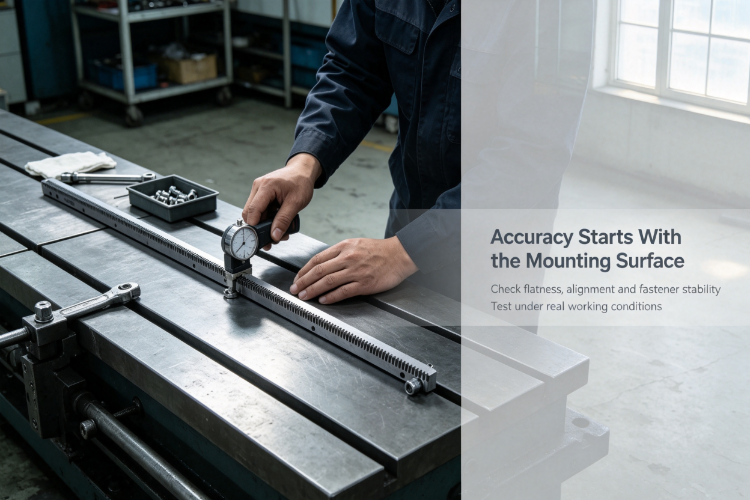
A rack bolted to an uneven surface develops alignment variation along its travel. A pinion set at the wrong position produces uneven contact. Flatness of the mounting surface, shaft rigidity, bearing support, and fastener stability all deserve attention at assembly and again during maintenance.
Variable Loads
Machines rarely repeat identical conditions. Acceleration, changing cutting resistance, and different payloads flex the structure. If the supporting frame lacks stiffness, elastic deformation shifts the real position even when the teeth are in good condition. Accuracy should therefore be judged under representative working conditions rather than from component specifications alone.
Why Does Noise Occur?
Noise control focuses on limiting vibration at the point of engagement and keeping it from spreading through the machine.
Tooth Engagement
Abrupt changes in contact create vibration. Spur teeth are straight and engage across the full width at once, which suits many conventional drives. Helical teeth are angled and enter contact gradually, softening the transition and often giving smoother running.
Resonance
The frame, brackets, and bearing housings can transmit or amplify vibration. A drive on a flexible structure may sound rough even when the gear mesh itself is well controlled, so the whole assembly should be examined rather than the gear set alone.
Lubrication and Surface Condition
Lubricant reduces friction and supports stable engagement. When it is insufficient or unsuitable, wear increases and the sound changes. Useful habits include choosing a lubricant compatible with materials and environment, keeping to a regular interval, checking for contamination, inspecting tooth surfaces, and investigating any change in sound.
How Do Helical and Spur Arrangements Compare?
Neither configuration guarantees a particular positioning result. They simply bring different engineering considerations. A Helical Rack Gear uses angled teeth that engage progressively. This reduces abrupt contact, spreads load across the engagement area, and can lower meshing noise in a well-designed system. The trade-off is axial thrust, which the bearings and supporting structure must absorb. A Spur Gear Rack and Pinion uses straight teeth and has no inherent axial thrust. It suits applications that prefer a simple transmission, need to avoid axial loading, or value straightforward maintenance and replacement. With good manufacturing quality, backlash control, and installation, it can also position accurately.
| Factor |
Helical Rack Gear |
Spur Gear Rack and Pinion |
| Tooth geometry |
Angled |
Straight |
| Engagement |
Progressive |
Direct |
| Smoothness |
Generally smoother |
Depends on design and conditions |
| Meshing noise |
Often lower |
Needs attention to engagement and vibration |
| Axial thrust |
Present |
None inherent |
| Backlash management |
Needs suitable adjustment |
Needs suitable adjustment |
| Positioning accuracy |
Depends on the whole system |
Depends on the whole system |
| Main considerations |
Axial support and alignment |
Tooth contact and mounting accuracy |
A quieter mesh does not make a drive more accurate, and a simpler tooth form does not stop a spur system from positioning consistently.
How Does Helical Rack Pinion Design Affect Results?
The pinion converts motor rotation into linear travel, so it must match the rack geometry and the limits of its supporting structure.
Tooth Contact
Matched profiles give consistent engagement and avoid localized loading. When selecting a Helical Rack Pinion, review compatibility with the rack teeth, profile accuracy, surface finish, material, load distribution, and operating speed.
Preload
Preloading narrows tooth clearance, but too much raises contact force, friction, and heat. The right amount depends on load direction, movement pattern, acceleration, and maintenance conditions.
Bearing Support
Helical teeth push the pinion along its axis. Without adequate bearings, the shaft can move and disturb tooth contact, so a properly designed bearing assembly keeps the pinion in position as loads change.
What Practical Steps Improve Accuracy and Reduce Noise?
Start by finding the actual source. Replacing a gear set without checking installation and support may leave the original fault in place.
- Check compatibility. Confirm matching tooth geometry, tolerances, materials, and surface condition.
- Control backlash. Decide whether preload is appropriate and watch its effect on friction, temperature, and wear.
- Verify alignment. Inspect the rack surface and pinion position, and confirm even contact along the full travel.
- Stiffen the structure. Look for movement in bearing housings, brackets, and frames, and add support where needed.
- Maintain lubrication. Match the method to material, environment, and duty, and inspect for contamination and abnormal wear.
- Test under real conditions. Observe acceleration, deceleration, reversals, and load changes. Position feedback, vibration monitoring, and operating sound reveal problems a static check cannot.
How Should the Right System Be Chosen?
Selection should start from the machine's requirements, not from a preference for one tooth form. For precision machining or automated assembly, review required accuracy, repeatability, backlash allowance, load variation, stiffness, and the feedback and control arrangement. Either a Helical Rack Gear or a Spur Gear Rack and Pinion can meet different positioning needs when properly specified and integrated. Where noise is a concern, consider tooth engagement, lubrication, speed, resonance, and bearing support together. A Helical Rack Pinion may fit when smoother engagement is required and the structure can handle axial thrust.
What Should Buyers Discuss With a Supplier?
A useful supplier conversation goes beyond dimensions. Topics worth covering include application and operating conditions, rack and pinion compatibility, material and manufacturing options, inspection procedures, installation recommendations, and support during system integration. Engineers planning a new motion system or improving an existing machine are welcome to contact our team with drawings, load conditions, movement requirements, and installation constraints to discuss Helical Rack Gear, Helical Rack Pinion, and Spur Gear Rack and Pinion configurations.


 English
 中文简体
 русский
 Español


 +86-13306862930 / +86-18668881826