

 English
 中文简体
 русский
 Español


Industry News
 +86-13306862930 / +86-18668881826
Get a Quote
+86-13306862930 / +86-18668881826
Machines that position a carriage, shift a load, or adjust a tool along a straight path often depend on a rack and pinion. The pinion turns, its teeth engage the rack, and rotary motion becomes controlled linear travel. The body of the rack shapes how it is mounted, supported, and fitted into the surrounding frame.
A Round Gear Rack has a cylindrical body and takes a different installation approach from a conventional flat rack. It can suit layouts built around round supports or holders. Helical designs, including Helical Racks and a Helical Rack and Pinion system, answer a separate question about tooth engagement. Choosing well means matching each feature to the machine and not picking by shape alone.
The rack carries teeth along its length, and the pinion is the rotating gear that meshes with them. As the pinion turns, the rack or the connected component moves in a line. In a round design the teeth sit on a cylindrical body, which is positioned inside a suitable support or holder. Alignment between rack, pinion, and moving structure still decides how the system runs.
The round shape offers installation flexibility without making the rack suitable for every machine. Tooth form, support, material, lubrication, and working forces all affect performance.
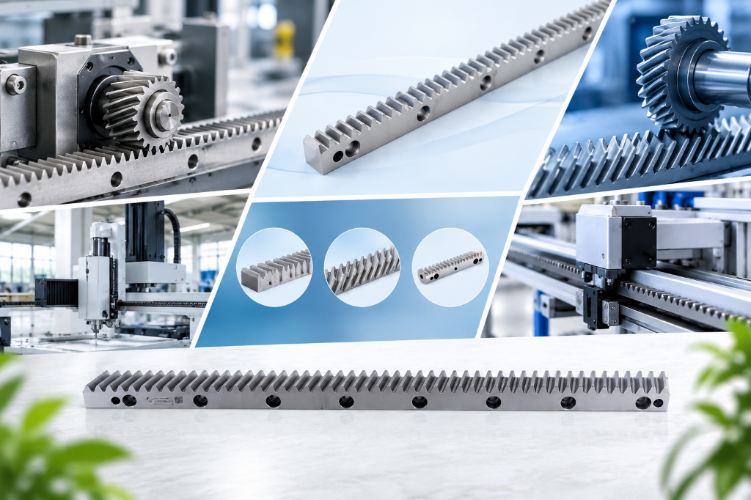
A round rack makes sense when the layout favors a cylindrical mounting form, such as a narrow support area or a structure easier to build around a round part. It can also be fitted into an existing assembly through dedicated holders, provided those holders keep the rack aligned with the pinion throughout travel.
| Application Situation | Why a Round Rack May Be Considered |
|---|---|
| Compact machine layout | Cylindrical body may fit a suitable mounting arrangement |
| Custom equipment design | Round form can be built into a purpose-made support |
| Guided linear movement | A compatible support helps hold the intended path |
| Limited mounting surfaces | A round profile may suit the available structure |
| Replacement or redesign | Existing mounting arrangement may influence the choice |
Start from the machine's real requirements. If a frame was designed for a flat rack, switching to a round one may call for extra modifications and not simplify anything.
A flat rack bolts to a broad surface, which makes alignment straightforward when the machine provides a flat reference face. A round rack needs holders or brackets that prevent unwanted movement.
| Design Feature | Round Gear Rack | Flat Gear Rack |
|---|---|---|
| Body shape | Cylindrical | Flat or bar-shaped |
| Mounting approach | Round-body supports | Compatible flat surface |
| Alignment method | Controlled through its supports | Prepared mounting face as reference |
| Key consideration | Support placement and orientation | Mounting surface and fixing |
Neither suits every job. The comparison that counts is how each rack fits the whole machine.
If the rack shifts, bends, or rotates unintentionally, the teeth stop engaging as designed, and movement quality suffers while wear rises. Plan the support, mounting stiffness, pinion position, and travel path together.
A rack that fits physically may still fail if its supports cannot hold alignment.
The rack must handle the force needed to move the load, resistance from guides, and forces from changes in motion. Supports must resist deflection. A carriage moving constantly along a defined path stresses the system differently from an occasional adjustment mechanism, and duty cycle affects material and lubrication choices.
A rack in a clean indoor machine faces different conditions from one exposed to moisture or dust. Material influences wear, strength, and corrosion resistance, and it must work with the pinion and neighboring parts. Shape alone is a poor reason to choose.
Inspection reveals wear, contamination, loose supports, or shifting alignment early. Cleaning removes debris that disturbs tooth contact, and lubrication reduces friction where the design requires it. Follow the manufacturer's guidance, since methods differ between products. Check the holders too, because a loose support can ruin alignment while the teeth still look sound.
Helical Racks have teeth cut at an angle to the rack's length. Contact develops gradually as the pinion turns, which can give smoother motion and quieter operation in a suitable system. This helps where movement quality matters.
The angled teeth also create forces that the structure must absorb. Bearings, guides, and supports need to suit them, so a helical rack is not a drop-in replacement for another type. Rack and pinion must share compatible tooth geometry, because a mismatch causes poor contact, extra wear, or uneven movement. A Helical Rack Gear paired with the wrong pinion will not perform as intended.
"Round" describes the body, while "helical" describes the teeth. They are different features, so comparing them directly depends on the specific product.
| Design Question | What to Ask |
|---|---|
| Machine frame | Does it suit the rack's mounting form? |
| Support layout | Can the rack stay stable along its working length? |
| Pinion placement | Can the pinion engage without interference? |
| Service access | Can the rack be inspected conveniently? |
A Round Gear Rack suits a cylindrical mounting design, while a Helical Rack and Pinion system suits applications where angled engagement and motion character matter. Automation carriages, material-handling structures, and custom machinery may use either, and two machines in one industry can need different answers.
Describe the machine and its motion before requesting a product. These questions give a supplier a clear basis:
Answers separate products that look alike but serve different installations. Judge the rack together with its pinion, supports, guides, and drive, and the choice of a round, flat, or helical design follows from the layout and the motion it must deliver.

© 2025 Zhejiang Yuchen Transmission Technology Co., Ltd.

Transmission Gear And Rack


