

 English
 中文简体
中文简体 русский
 Español

Industry News
Home / News / Industry News / How a Helical Gear Rack and Pinion Produces Less Noise Than a Spur Rack
 +86-13306862930 / +86-18668881826
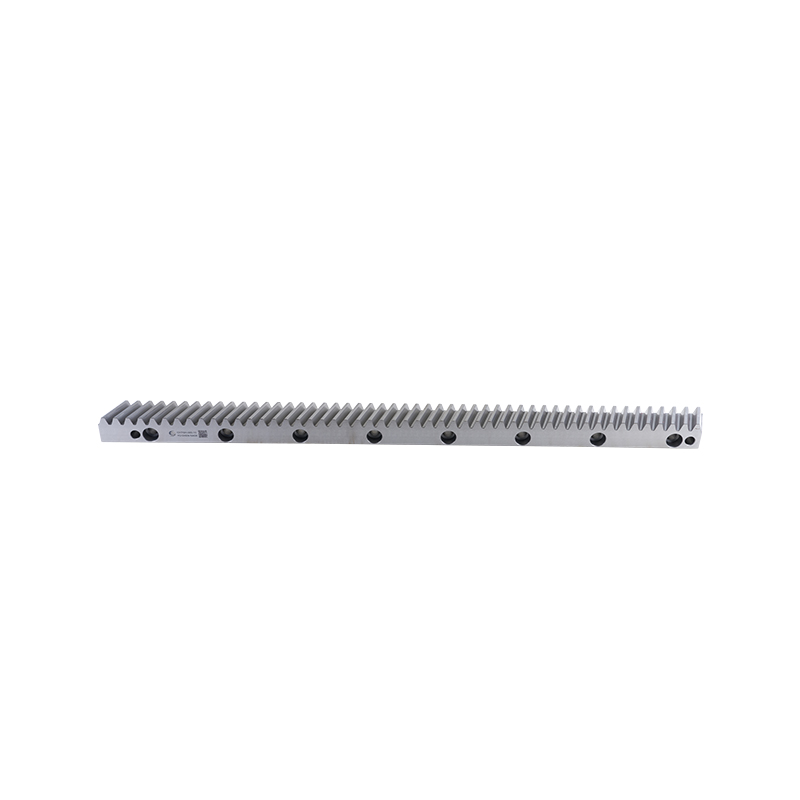
Set a helical gear rack next to a spur rack, and the difference catches the eye right away. The teeth on the helical version slant across the face rather than standing straight up. They lean over at an angle, like a spiral staircase that has been laid flat. That angled shape changes nearly everything about how the system operates.
The rack looks like a straight bar with teeth cut along one edge. The pinion, a round gear, rotates against the rack to turn rotary motion into straight-line movement. In a helical gear rack and pinion, both the rack teeth and the pinion teeth carry that same lean angle. The tooth lines wrap around the pinion in a helix pattern and run diagonally along the rack face. That geometry alters how the teeth meet each other during operation.
These systems find their way into equipment where smooth, quiet movement matters. Machine tools, automotive steering, and precision positioning gear often rely on them. The angled tooth design gives them an advantage in settings where noise and vibration would cause trouble.
Gear noise starts with teeth hitting teeth. Each time a pair of teeth comes together and then pulls apart, a small impact happens. The character of that impact determines how much sound comes out of the system. The way teeth meet and separate shapes the acoustic output.
A tooth that slams into its mating surface all at once creates a sharp jolt. That jolt travels through the gear body, along the shaft, and into the housing, radiating outward as sound. A tooth that slides gradually into engagement produces a gentler transition. The energy spreads out over time, reducing the peak force at any instant. Lower peak forces mean less vibration and less noise.
The curve of the tooth profile also plays a part. Involute curves, the standard shape for most gears, naturally produce a rolling action as teeth mesh. But even within that standard geometry, the angle of the tooth relative to the gear axis changes how the meshing happens.
Spur gear teeth run parallel to the gear axis. When a spur pinion meets a spur rack, the whole width of a tooth contacts at once. One tooth pair engages fully, carries the load, and then lets go just as suddenly as it came in. The shift from no contact to full contact happens in an instant.
That instant contact creates a repetitive bang as each tooth pair goes through its cycle. Each bang sends a pulse through the system, and those pulses add up to a whine or whirring sound. The frequency of that sound depends on how many teeth there are and how fast the gear turns.
Spur racks also suffer from what gear people call transmission error. Tiny differences in tooth spacing or shape cause the gear pair to speed up and slow down slightly as teeth mesh. Those speed variations show up as vibration, which turns into noise. The straight tooth design offers nothing to smooth out those variations.
Helical teeth come together gradually. As a helical pinion rotates, the angled tooth enters contact at one end and then rolls into full engagement across its width. At any given moment, only part of each tooth carries load. The rest of the tooth sits either just before or just after the contact zone.
That gradual engagement changes the loading pattern completely. Instead of a sudden impact, the helical gear rack and pinion experiences a smooth build-up of load followed by a gradual release. The tooth pairs overlap in their engagement cycles. One pair starts carrying load before the previous pair finishes. Several tooth pairs share the load at the same time.
The overlap, called contact ratio, measures how many tooth pairs carry load on average. Helical systems typically have higher contact ratios than spur systems because the angled teeth stay in contact longer. More teeth sharing the load means each individual tooth carries less force at any instant. Lower individual tooth loads produce smaller deflections and less vibration.
Contact ratio tells you the average number of tooth pairs in mesh during operation. A ratio of 1.0 means exactly one tooth pair carries the load at all times. A ratio of 1.5 means an average of one and a half tooth pairs share the load, with the extra half coming from overlapping engagement periods.
Spur gears with standard shapes typically produce contact ratios between 1.2 and 1.6, depending on the tooth geometry. Helical gears achieve higher ratios because the angled teeth effectively increase the length of the contact path. A helical gear rack and pinion can reach contact ratios of 2.0 or more without any special modifications.
The higher ratio reduces the fluctuation in mesh stiffness over the engagement cycle. When one tooth pair starts to unload, another pair has already begun to take up the load. The transition between tooth pairs becomes smoother, reducing the variation in force transmitted through the system. Less force variation translates directly into less vibration and less noise.
| Characteristic | Spur Rack System | Helical Rack and Pinion System |
|---|---|---|
| Tooth contact pattern | Full tooth engages at once | Gradual engagement across tooth width |
| Contact ratio | 1.2 - 1.6 typical | 2.0 or higher possible |
| Load transfer | Abrupt at mesh entry and exit | Smoother, with overlapping tooth pairs |
| Force variation | Higher fluctuation | Lower fluctuation |
| Vibration amplitude | Higher peaks | Lower peaks |
| Sound character | Whine with distinct harmonic content | Softer, higher frequency tone |
The smoother load transfer and higher contact ratio give the helical system a clear advantage in reducing noise. Each tooth pair enters and leaves the mesh gradually, and the overlapping engagement spreads the load across more teeth. The result is a quieter system with less harshness than an equivalent spur rack design.
Spur gears make a sound that people describe as whining or whirring. The teeth smack into each other at a certain frequency, and that frequency sits in a range the human ear picks up clearly. The harmonics, the overtones that accompany the main tone, add to the harshness. The overall effect can be tiring to listen to over long periods.
Helical gears shift the sound upward in frequency. The gradual engagement and higher contact ratio produce vibrations that happen faster but with less amplitude. The human ear responds differently to higher frequencies. A high-pitched hum often sounds softer than a lower-pitched whine, even when the measured decibel levels read similar. The character of the sound matters to how people perceive it.
The sound from a helical gear rack and pinion also contains fewer strong harmonics. The smooth engagement reduces the abrupt changes that generate overtones. The result comes across as a cleaner, less intrusive noise. In applications where operators sit near the equipment for hours, that difference makes itself felt in fatigue levels and overall work environment comfort.
A helical gear rack factory that takes noise seriously puts effort into several areas. Manufacturing precision leads the list. Teeth that follow the intended helix angle exactly produce smoother engagement. Teeth that deviate from that angle, even slightly, create uneven contact and additional noise. The factory uses measuring equipment to check helix angle, tooth spacing, and profile accuracy on every production batch.
Tooth finishing makes a difference as well. Grinding or honing operations remove the microscopic roughness left by cutting processes. Smoother tooth surfaces slide past each other with less friction and less vibration. The finishing process also improves the consistency of tooth geometry across the entire rack length. A rack with uniform teeth produces a uniform mesh throughout its travel.
Material selection enters the noise equation too. Some gear materials have internal damping properties that absorb vibration energy. Cast iron and certain polymers dissipate vibration better than hardened steel. The factory may recommend materials based on the specific noise requirements of the application. Harder materials wear longer but may transmit more noise. Softer materials quiet the system but sacrifice some load capacity.
The material running through a helical gear rack and pinion affects more than just strength. Damping capacity, the ability to absorb vibration energy, varies widely across material classes. Cast iron provides good damping. Steel offers less. Polymers and plastics provide high damping but have limited load capacity and wear resistance. The choice involves balancing noise requirements against strength, wear life, and cost.
Lubrication acts as a cushion between meshing teeth. The lubricant film separates the tooth surfaces enough to prevent metal-to-metal contact. A thicker film provides more cushioning and reduces impact noise. The film also dampens vibration that would otherwise travel through the gear body. Using the right viscosity and additive package maintains this film under operating temperatures and loads.
Temperature changes the lubricant's effectiveness. Cold oil flows poorly and may not form a full film. Hot oil thins out and may not stay between the teeth under heavy load. The factory often provides guidance on lubricant selection for different operating conditions. Following that guidance keeps the system running quietly over its service life.
The quietest helical gear rack and pinion will make noise if installed poorly. Alignment matters more than many people realise. The pinion axis must remain parallel to the rack face and perpendicular to the travel direction. Misalignment causes the teeth to contact at the wrong angle, creating localized loading and increased noise. Small alignment errors that seem insignificant during assembly show up clearly in the sound output.
Mounting rigidity affects noise transmission. A rack bolted to a flexible structure will vibrate and radiate more sound than one mounted to a rigid foundation. The mounting points must support the rack evenly to prevent it from bowing or twisting under load. Any movement between the rack and its mounting surface generates vibration that translates into noise.
Backlash and preload settings influence the engagement dynamics. Too much backlash allows the teeth to separate and re-engage with impact, creating noise. Too little preload may cause the teeth to bind, increasing friction and potentially generating noise from the sliding contact. Finding the right balance for each application requires understanding how the system operates under its particular load and speed conditions.
The quiet operation of a helical gear rack and pinion comes with some trade-offs. The angled teeth generate axial thrust, a force that pushes the pinion along its axis. Bearings must handle this thrust load in addition to the radial load from tooth contact. Spur systems, with their straight teeth, produce no axial thrust. Supporting the extra load increases bearing cost and complexity.
Manufacturing a helical gear rack and pinion costs more than a spur equivalent. Cutting angled teeth requires different tooling and more setup time. The tooth geometry must be controlled to tighter tolerances to achieve the quieter operation. Grinding or finishing helical teeth adds another operation to the production process. These factors increase the price of the finished components.
Efficiency differences exist between the two designs. The sliding action in helical engagement creates some friction losses that spur gears do not experience. The loss is small, often a few percent, but it matters in applications where every bit of efficiency counts. High-speed or high-power applications may favour spur designs for that reason alone.
| Consideration | Helical Rack and Pinion | Spur Rack |
|---|---|---|
| Axial thrust | Present, requires thrust bearings | None |
| Manufacturing cost | Higher due to angled tooth cutting | Lower |
| Efficiency | Slightly lower due to sliding friction | Slightly higher |
| Noise output | Lower, with softer character | Higher, with more harshness |
| Load capacity | Higher due to multiple tooth contact | Lower |
| Suitability for high speed | Good with proper lubrication | Better due to no axial thrust |
The choice between helical and spur systems comes down to what matters most in the application. For those who need quiet, smooth motion, the helical gear rack and pinion offers clear advantages. The softer sound, reduced vibration, and smoother operation improve the user experience and often extend component life. The added cost and complexity of the helical system pay for themselves in applications where noise matters. For simpler systems where noise is not a concern, spur racks continue to do the job at lower cost.

© 2025 Zhejiang Yuchen Transmission Technology Co., Ltd.

Transmission Gear And Rack


