

 English
 中文简体
中文简体 русский
 Español

Industry News
 +86-13306862930 / +86-18668881826
Get a Quote
+86-13306862930 / +86-18668881826
Rack systems turn rotary motion into linear movement, which makes them useful in equipment that needs controlled travel along a straight path. They show up in automation equipment, positioning systems, gates, lifting structures, and various types of industrial machinery running on a factory floor.
At a glance, a spur rack and a helical rack can look genuinely similar sitting side by side. Both work with a matching gear or pinion, and both can transfer movement along a straight rack. The difference comes from how their teeth are arranged and how those teeth meet during operation, not from the overall shape of the part.
This difference affects the way the system moves, the sound it produces, the way loads get transferred, and how the rack fits a particular machine on the shop floor. Understanding these distinctions can help buyers choose between a spur and a helical arrangement without selecting a product based only on appearance.
A spur rack uses straight teeth arranged across the length of the rack itself. Its matching pinion has a corresponding tooth arrangement, allowing the two components to engage as the pinion rotates through its cycle.
The basic movement is genuinely easy to understand. The pinion turns, and the rack moves along its length in response. A spur rack and pinion arrangement is therefore suitable for applications where straightforward linear movement matters more than a softer engagement between the teeth.
| Feature | Spur Rack System |
|---|---|
| Tooth direction | Straight across the rack |
| Movement | Rotary motion converted into linear travel |
| Matching part | Spur pinion |
| Installation | Relatively straightforward |
| Common consideration | Simple movement and practical maintenance |
The simple tooth arrangement can also make the system genuinely easier to identify during equipment selection. For machinery that doesn't require a more gradual tooth engagement, this kind of setup may provide a practical mechanical arrangement worth considering.
A helical rack uses teeth arranged at an angle, rather than running straight across the rack body. This changes the way the rack and pinion meet during movement, since the angled tooth arrangement allows engagement to develop progressively as the matching parts rotate together.
A helical arrangement can therefore create a genuinely different operating feel from its straight-tooth counterpart. The difference isn't simply visual here. It influences how contact develops between the rack and pinion and how the system behaves while moving through its cycle.
| Feature | Helical Rack System |
|---|---|
| Tooth direction | Angled along the rack |
| Movement | Rotary motion converted into linear travel |
| Matching part | Helical pinion |
| Engagement | More gradual tooth contact |
| Common consideration | Smooth movement and operating feel |
The suitability of this kind of system still depends on the machine around it. The rack, pinion, mounting arrangement, and surrounding components need to work as a compatible set, not as parts chosen independently.
Tooth direction is the clearest physical difference between the two rack families. Straight teeth meet their matching pinion in a direct manner, while angled teeth create a genuinely different contact pattern as they rotate through engagement.
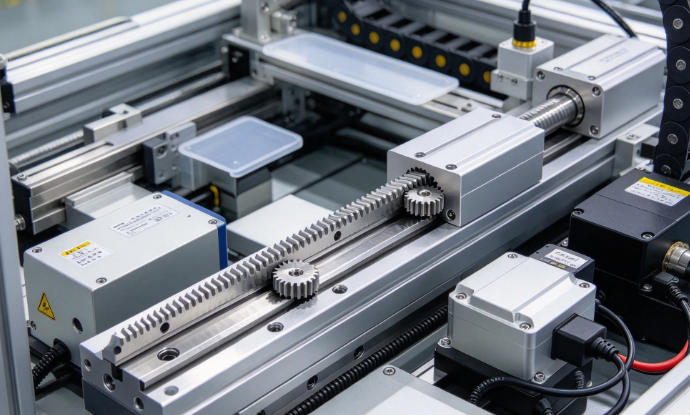
This affects how the teeth enter and leave contact during a movement cycle. For a spur arrangement, the straight tooth structure keeps the connection relatively direct throughout. A helical layout uses an angled arrangement that changes the way contact develops moment to moment.
The difference can influence how the machine feels during movement on the floor. It can also affect the noise produced by the mechanism and the way the system responds when movement changes direction mid-cycle. For equipment designers, tooth direction is therefore genuinely more than a visual feature. It's part of the movement characteristics belonging to the entire rack system.
A spur rack can prove attractive when a machine needs a genuinely simple rack-and-pinion arrangement without extra complexity. The straight tooth design is relatively easy to understand at a glance, and it also makes the relationship between the rack and pinion clear during installation on site.
This can prove useful for equipment where the rack system needs to remain accessible for inspection or replacement down the line. This kind of arrangement may also fit applications where movement requirements stay straightforward and there's no particular need for the characteristics associated with angled teeth.
Ease of use doesn't mean every straight-tooth system will suit every machine on the floor, though. The surrounding structure still needs to provide suitable alignment, support, and clearance for the parts to work correctly together.
Helical racks can get considered when smoother engagement forms an important part of the equipment's operating behavior. Because the teeth sit angled, engagement develops genuinely differently from a straight-tooth system running the same cycle.
This can help create a more gradual transition as the pinion moves along the rack length. This kind of rack can therefore prove useful in machinery where the feel of movement matters to the operator or the process itself.
Examples may include automated positioning equipment, machinery that moves repeatedly along a guided path, and systems where operating noise is a genuine consideration for the surrounding workspace. The rack itself is only one part of the result, though. The matching pinion and the rest of the drive system also influence how the equipment ultimately behaves.
The difference becomes genuinely easier to understand when looking at the movement of the pinion itself. A straight-tooth arrangement uses direct tooth engagement throughout, while an angled arrangement introduces progressive contact between the rack and pinion as they meet.
This creates genuinely different operating characteristics worth comparing side by side.
| Movement Consideration | Spur System | Helical System |
|---|---|---|
| Tooth engagement | Direct | Progressive |
| Movement feel | Straightforward | More gradual |
| Sound consideration | Depends on the machine | Often considered when quieter movement matters |
| Structural needs | Relatively simple | Requires suitable matching components |
| Application focus | Practical linear movement | Smooth and controlled movement |
Neither arrangement should get selected simply because one appears more sophisticated on paper. The correct choice depends on the machine's movement requirements and the conditions surrounding the rack itself.
Maintenance needs get influenced by the complete machine, rather than the rack tooth shape alone sitting in isolation. Both systems need suitable inspection and care throughout their working life. The rack and pinion need to remain properly positioned, and the contact surfaces need staying in suitable condition for the application at hand.
A straight-tooth rack can be relatively straightforward to inspect because its teeth are genuinely easy to see during a quick check. An angled rack may require more attention to the relationship between the rack and its matching pinion, since the contact pattern isn't as visually obvious.
| Maintenance Area | Spur Rack | Helical Rack |
|---|---|---|
| Tooth inspection | Straightforward visual inspection | Requires attention to angled contact |
| Matching pinion | Spur type | Helical type |
| Alignment | Important | Important |
| Cleaning | Depends on application | Depends on application |
| Replacement | Match tooth arrangement | Match tooth arrangement and direction |
Good maintenance begins with using genuinely compatible components from the start. Replacing an angled rack with a straight-tooth component, or the other way around, isn't simply a matter of choosing a similar-looking part off a shelf.
No, and this deserves clear attention before ordering. The rack and pinion need designing as a compatible pair from the outset. A straight-tooth rack requires a matching straight-tooth pinion, while an angled rack requires a corresponding angled pinion built to match its geometry.
This proves particularly important during replacement work on existing equipment. A buyer searching for a spur arrangement should make sure the rack and pinion belong to the same connection family, and the same principle applies when sourcing a helical setup instead.
The product name alone may not provide enough information to confirm this. Buyers should confirm the tooth arrangement and other relevant product details with the supplier directly before an order goes out the door.
A Round Gear Rack and Pinion represents another approach to linear movement worth knowing about. Unlike a flat rack, a round rack has a cylindrical form. Its structure can make it suitable for particular equipment layouts where a round profile fits the surrounding components more naturally than a flat one would.
This creates a genuinely useful three-way comparison for buyers weighing their options.
| Rack Type | Basic Structure | Main Selection Consideration |
|---|---|---|
| Spur rack | Straight teeth on a rack | Simple linear movement |
| Helical rack | Angled teeth on a rack | Gradual engagement |
| Round rack | Circular rack body | Equipment structure and installation |
The choice therefore isn't only between two straight-versus-angled options. Machine designers may also need considering whether a flat rack or round rack better fits the available space and supporting structure around it.
The application should guide the selection, rather than the product name alone catching someone's eye. A simple automated gate may have genuinely different needs from a positioning machine running precision cycles. A machine that moves a platform repeatedly may require genuinely different movement characteristics from equipment that performs occasional linear travel between tasks.
A straight-tooth system can suit applications where direct movement and straightforward installation matter most to the crew handling it. An angled system can get considered where gradual engagement and a smoother operating feel prove useful to the process. A round rack may become relevant when the physical structure of the machine makes a cylindrical profile more suitable than a flat one.
The surrounding system should always get considered as a whole, rather than picking the rack in isolation from everything else.
Noise can become genuinely noticeable when machinery moves repeatedly throughout a shift. The sound produced by a rack system depends on several factors, including tooth engagement, installation, surrounding components, lubrication, and the condition of the mechanism itself over time.
The difference between straight and angled teeth can influence this experience considerably. An angled arrangement can provide a more gradual engagement pattern, which may prove useful in applications where operating sound needs genuine consideration in the surrounding workspace.
A straight-tooth arrangement can still prove suitable when noise isn't a major concern, or when other machine requirements take priority over quiet operation. Noise should therefore get treated as one selection factor, rather than a reason to automatically favor one rack family over another.
Even a genuinely suitable rack can perform poorly if it gets installed without sufficient attention to the surrounding structure. The rack needs to remain properly positioned relative to the pinion throughout its travel, and the supporting surface also needs to provide suitable stability during operation.
For a straight-tooth rack, the tooth arrangement makes the relationship between rack and pinion relatively easy to observe during setup. For an angled rack, the tooth structure means the matching pinion needs positioning appropriately to maintain correct contact as the parts move together.
Installation should therefore follow the product's intended design, rather than relying on visual similarity to a different part. This proves particularly important when a rack is getting added to existing equipment already on the floor.
Industrial buyers often need comparing products from different suppliers before settling on one. The comparison becomes genuinely easier when it's based on the actual application, rather than a general preference for one rack family over another.
Useful questions include what type of movement the machine requires, and whether the rack will move frequently or only occasionally. Whether operating noise matters deserves asking too, along with what type of pinion is already installed on the existing equipment. Whether the available space suits a flat or round rack comes next, along with how the rack will get mounted and whether replacement parts will need sourcing later. Whether the supplier provides clear product information rounds out the checklist worth working through.
These questions can help narrow the selection considerably. They also give suppliers genuinely useful information when recommending a suitable rack arrangement for the job.
A rack supplier can play a genuinely important role when buyers feel uncertain about the difference between product families. A straight-tooth arrangement should get discussed according to the machine's actual movement requirements on the floor, rather than assumptions based on a catalog photo.
An angled arrangement should get evaluated in relation to the matching pinion, installation arrangement, and desired operating characteristics for the application. Suppliers can also help buyers distinguish between standard rack forms and application-specific designs built for a particular job.
For B2B procurement, useful communication may cover equipment application first, then the existing rack and pinion arrangement already in place. Required movement type matters next, along with installation structure, replacement needs, operating environment, and product compatibility overall. This creates a genuinely clearer connection between the selected rack and the machine in which it will get installed.
The choice between these two rack families is ultimately connected to how the machine needs to move through its cycle. A straight-tooth rack provides a direct tooth arrangement that can suit straightforward linear motion well. An angled rack introduces a different engagement pattern that can suit equipment where movement smoothness and operating behavior receive genuinely greater attention from the design team.
A spur setup can prove appropriate when simplicity and direct movement fit the machine's needs closely. A helical setup may get considered when the equipment calls for a genuinely different contact pattern between the rack and pinion involved. A round gear rack adds another option when the rack's physical shape needs to fit a particular machine structure that a flat profile wouldn't suit.
The selection process becomes genuinely clearer when buyers look beyond the rack itself and consider the pinion, mounting arrangement, movement requirements, maintenance approach, and future replacement needs as parts of the same connected system.

© 2025 Zhejiang Yuchen Transmission Technology Co., Ltd.

Transmission Gear And Rack


