+86-13306862930 / +86-18668881826

Get a Quote
+86-13306862930 / +86-18668881826
Industrial systems rely on coordinated movement, whether inside automated lines, lifting platforms, or precision machinery. A Gear And Rack Manufacturer plays a central role in this ecosystem by producing components that convert rotational force into controlled linear motion.
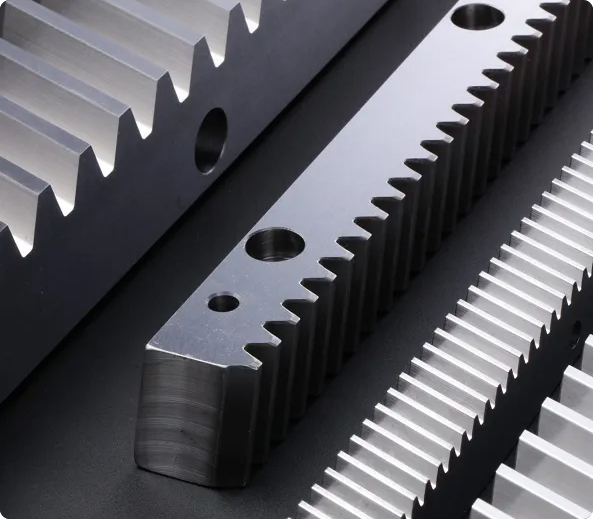
Factories across sectors increasingly look for transmission solutions that maintain steady positioning while adapting to repeated cycles. When racks and gears operate smoothly together, equipment can perform tasks such as alignment, material transfer, or directional adjustment with greater predictability.
As production environments continue evolving toward automation, dependable motion components remain closely tied to operational continuity.
Procurement teams rarely focus on a single specification. When evaluating a Gear And Rack Manufacturer, buyers often examine machining capability, inspection methods, and tolerance management.
Precision attracts attention because even small dimensional variations can influence how components mesh. Consistent tooth geometry supports quieter interaction and balanced load distribution, both of which matter in facilities operating for extended hours.
Another consideration involves documentation. Technical drawings, measurement reports, and traceable batch data can help engineering teams verify compatibility before installation begins.
Material choice often reflects the intended working environment. Carbon steel remains widely used due to its structural strength, while alloy variants attract buyers searching for enhanced wear resistance.
A versatile Gear And Rack Manufacturer may provide surface treatments such as carburizing or nitriding, processes that modify outer layers to support durability under repeated contact.
For applications requiring reduced weight, some buyers explore alternative metals that maintain rigidity while easing system load. Selecting the appropriate material often depends on torque demands, exposure conditions, and operational frequency.
Linear motion depends on accurate engagement between gear teeth and rack profiles. Within a Gear And Rack Manufacturer, CNC machining frequently supports repeatable production by guiding cutting tools along programmed paths.
Grinding processes can further refine tooth surfaces, helping components interact with less vibration. This level of finishing often appeals to industries where positional accuracy contributes to product quality.
Inspection tools such as coordinate measuring machines allow technicians to compare finished parts against design parameters, supporting alignment with engineering requirements.
Industrial buyers increasingly request tailored solutions rather than standardized dimensions. Collaborating with a Gear And Rack Manufacturer allows engineers to adjust module size, pressure angle, length, or mounting features to match specific machinery layouts.
Customization may also involve drilling patterns or protective coatings suited to unique installation conditions. These adjustments help components integrate into existing assemblies without extensive redesign.
For equipment builders, this flexibility supports product differentiation while maintaining mechanical coherence.
Heat treatment processes alter metal structure, shaping how gears respond to friction and load. Inside a Gear And Rack Manufacturer, controlled heating and cooling cycles can increase surface hardness while preserving inner toughness.
This combination helps components tolerate repeated engagement without rapid deformation. Buyers operating heavy equipment often review treatment specifications to align parts with expected workload patterns.
Understanding these processes provides clearer insight into how transmission components may behave over time.
Structured inspection routines help maintain uniform output across batches. Many facilities implement multi-stage reviews, beginning with raw material verification and continuing through machining checks.
At a Gear And Rack Manufacturer, technicians may test tooth spacing, straightness, and finish before approving parts for shipment. Such evaluations support smoother installation once components reach assembly lines.
Packaging practices also contribute to product condition. Protective coatings and secure wrapping help reduce exposure during transit.

© 2025 Zhejiang Yuchen Transmission Technology Co., Ltd.

Transmission Gear And Rack



 English
 中文简体
中文简体 русский
 Español