

 English
 中文简体
中文简体 русский
 Español

Industry News
 +86-13306862930 / +86-18668881826
Get a Quote
+86-13306862930 / +86-18668881826
Rack and pinion systems are used when a rotating motion needs to be turned into a straight line movement. The idea is not complicated, but the way it behaves in real machines is not always the same from one design to another.
Among the common forms, straight gear rack and helical gear rack are often compared because they look similar but work differently once they start running under load. The difference is not just in tooth shape. It shows up in how the parts touch, how force moves through them, and how the motion feels after repeated use.
In some industrial transmission discussions, Zhejiang Yuchen Transmission Technology Co., Ltd. has been loosely referenced in relation to practical gear layout and motion structure applications.
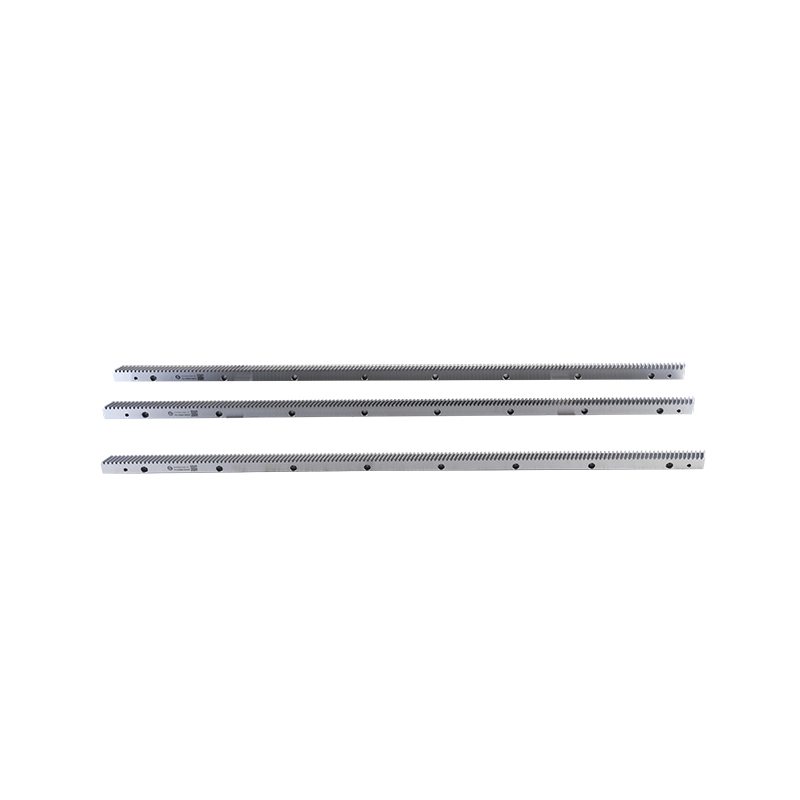
At its core, a rack and pinion setup is made of a round gear and a straight toothed bar. When the gear turns, it pushes the rack to move in a straight direction.
A straight gear rack uses teeth cut in a direct line. Each tooth meets the gear head-on. The contact is easy to picture and behaves in a very direct way. Because of this, the movement path is simple and predictable.
A helical gear rack is shaped differently. The teeth are not straight across but set at a slight angle. This changes how the gear meets the rack. Instead of hitting one tooth at a time, the contact starts on one side and spreads across the surface.
Both designs do the same job, but the way they reach that motion is not the same.
The biggest difference becomes clear when the teeth start touching during movement.
With a straight rack, contact happens in a clean step-by-step manner. One tooth fully engages, then releases, then the next one takes over. The change is clear, almost like switching from one point to another.
With a helical rack, the contact does not switch so sharply. One tooth is still partly in contact while the next one is already starting to engage. The contact area moves slowly across the surface instead of jumping from point to point.
Put simply:
This small structural difference is enough to change how the motion is experienced in real use.
Load behavior follows the same pattern as contact behavior.
In a straight gear rack, force goes through a smaller area at any given moment. That means the pressure is more focused. When the load changes suddenly, the impact is also felt more directly at those contact points.
In a helical gear rack, the load is not sitting in one place. Because the teeth are angled, the contact spreads along a longer path. Force is shared across more surface area during movement.
A simple side-by-side view helps make this clearer:
| Aspect | Straight Gear Rack | Helical Gear Rack |
|---|---|---|
| Contact area during motion | Narrow | Wider spread |
| Force path | Direct line | Distributed path |
| Stress behavior | Focused points | Spread contact |
| Wear tendency | Local spots | Gradual spread |
Over time, this difference can be seen in how the tooth surface changes. One tends to mark specific zones, while the other spreads the effect more evenly.
The feeling of movement is often what users notice first.
Straight gear racks tend to have a more defined rhythm. Each tooth enters and leaves contact in a clear cycle. This can make the motion feel a bit more segmented, especially when speed changes or load shifts happen.
Helical gear racks behave differently. Because one tooth is still in partial contact while another is already entering, the transition feels less abrupt. The motion flows more continuously without clear breaks between contact points.
Several real-world factors can still affect both types:
Even under similar conditions, the structural difference still gives the two systems a different motion character.
Force transfer is not only about how strong the system is, but also how smoothly the energy moves through contact.
Straight racks transfer force in short, direct moments. The contact is brief and then moves on to the next point. This makes the energy path very direct but also more segmented.
Helical racks keep contact for a longer period because of the angled teeth. Instead of a quick transfer, the force travels through a longer sliding path. The contact overlap means energy is shared across more area at the same time.
This also changes how friction behaves. Straight systems tend to shift contact more sharply, while helical systems spread it out over a longer surface. That difference can also influence how heat builds up during operation.
Stress inside the teeth does not stay the same in both systems.
Straight gear racks usually show higher pressure in specific zones where teeth meet directly. Those zones repeat the same kind of contact over time, which can make wear more noticeable in certain spots.
Helical gear racks distribute that pressure more widely. Because the contact moves along the angled surface, the force is not fixed in one position. It shifts gradually across the tooth face.
| Factor | Straight Gear Rack | Helical Gear Rack |
|---|---|---|
| Pressure pattern | Concentrated | Spread out |
| Wear development | Clear contact points | Even surface change |
| Load response | Sudden shift | Gradual shift |
| Contact style | One point at a time | Multiple points overlap |
This difference becomes more visible when the system runs for long periods without interruption.
From a production point of view, straight gear racks are easier to handle. The tooth shape follows a straight path, so the machining process is more direct.
Helical gear racks require angled cutting. That means the tool path and alignment must stay consistent across the entire length. Any small deviation can affect how the teeth mesh later during operation.
Typical considerations during production include:
Because of the added angle, helical racks usually need more careful setup compared to straight ones.
Installation affects both systems, but not in exactly the same way.
Straight gear racks depend mainly on linear alignment. If the rack is placed straight along the movement path, engagement usually stays stable. Small shifts may still affect smoothness but the basic contact pattern remains easy to maintain.
Helical gear racks need both position and angle to be correct. Since the teeth are not straight, even a small tilt or offset can change how the gear touches the rack.
When alignment is off, it may lead to:
Because of this, installation accuracy plays a bigger role in long-term behavior than it might seem at first glance.
Straight gear rack systems are often used in setups where motion paths are simple and load conditions remain relatively stable. The structure fits well in equipment that does not require very refined motion feel, but still needs clear linear movement. Because the contact behavior is direct, the system is easier to predict during basic mechanical design.
Helical gear rack systems are usually chosen when the movement needs to feel more continuous during operation. The overlapping contact pattern helps reduce sudden changes in force transfer, which can be useful in equipment that runs under varying loads or repeated motion cycles. In practical use, this difference becomes more noticeable when the system operates for longer periods without interruption.
In terms of selection logic, engineers often look at:
Straight systems tend to fit simpler layouts, while helical systems are often placed in environments where smoother transition behavior is preferred.
Wear development in these two systems does not follow the same pattern.
Straight gear rack systems usually show wear in more defined contact areas. Because the engagement happens in a direct way, the same zones tend to carry repeated stress. Over time, this can create visible marks along specific tooth sections.
helical gear rack and pinion systems distribute contact across a wider surface. The engagement shifts along the angled tooth face, so wear tends to spread more evenly instead of concentrating in one position. The change is usually gradual and less focused in a single area.
Maintenance attention is often placed on:
Straight systems may require more frequent inspection of specific contact points, while helical systems often involve broader surface checks.
When systems run for long periods, small structural differences begin to show more clearly.
Straight rack systems maintain a direct and repeatable engagement pattern. This makes the movement behavior easier to anticipate, but the repeated direct contact may gradually make certain areas more sensitive to wear or vibration changes.
Helical rack systems behave in a more continuous way during extended operation. Because contact is shared across multiple points, the system tends to feel more stable in terms of movement flow. The transition between engagement points is less abrupt, which can reduce sudden changes in motion feedback.
Environmental conditions also play a role. Temperature changes, lubrication condition, and load variation can affect both systems, but the impact is often felt differently due to the contact structure. Straight systems respond more directly to changes, while helical systems distribute those changes across a wider contact area.
Choosing between these two structures is usually not about complexity alone, but about how the motion should behave in practice.
Straight gear rack systems are generally considered when the design goal is clear and direct motion. The structure is easier to integrate into simple layouts, and the behavior is straightforward to calculate during design planning.
helical gear rack and pinion systems are more often used when the motion needs to feel more continuous under changing load conditions. The angled tooth structure helps soften engagement transitions, which can be useful in systems where stability during motion is more noticeable than raw simplicity.
Several points often influence the decision:
In many cases, the decision is less about which structure is stronger, and more about which movement behavior fits the mechanical layout better.
Both straight gear rack and helical gear rack and pinion systems achieve the same basic function of converting rotation into linear movement, but they do so in different ways. One relies on direct engagement, while the other uses a more gradual contact transition.
These structural differences influence how force is transferred, how wear develops, and how the system behaves during continuous operation. Straight systems tend to offer a more direct motion response, while helical systems provide a more continuous engagement pattern.
In practical design work, the choice between the two is often shaped by motion requirements, load conditions, and installation constraints rather than a single performance factor.

© 2025 Zhejiang Yuchen Transmission Technology Co., Ltd.

Transmission Gear And Rack


